
Things have gotten out of hand – way out of hand.
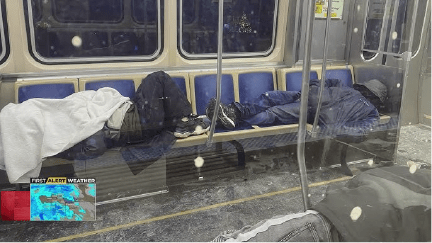
It has been shown that fare evaders are more likely to commit crimes while on board transit vehicles than paying customers. BART sources say that while the actual amount of fare evasion is unknown (estimates range from 20% to 40%), what is known is “that virtually everyone arrested for criminal behavior on a BART train is also a fare evader.”
Needless to add, criminal activity aboard transit vehicles does not attract new riders. In many cases it isn’t just the criminality that turns people away from transit use. A large percentage of the residents of the Bay Area are used to comfort and safety. For this reason (whether socially acceptable or not), many will not willingly sit down or ride with people who are dirty, unduly noisy, disruptive, combative, hostile or plain obnoxious. It’s just not going to happen.
Read more here:
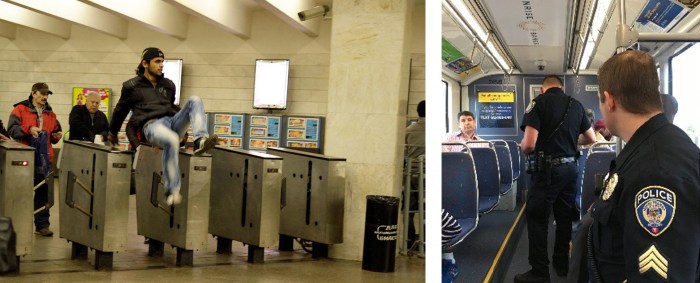
And then there’s the act of fare evasion itself. We paying customers quickly become aware of the fact that others aren’t paying and that makes us feel like suckers. When some riders are seen as evading fares with impunity a common reaction from many legitimate riders is: “why am I paying if no one else is “. Once fare evasion is tolerated it soon gets out of hand.
For starters, consider AC Transit’s 9.5 mile long T1 Bus Rapid Transit Line on International Blvd extending from the San Leandro BART station to downtown Oakland. AC Transit says that this service which began on August 9, 2020, is cutting trip times in half and therefore attracting a ridership of about 13,000 one- way riders per weekday. Given the high cost of building and setting up T1, 13,000 riders a day isn’t very impressive but at least it’s something. Until one realizes that AC Transit is managing to collect only an absurdly low 15 cents per rider!
AC Transit is by no means the only agency that is failing to collect fares. We have written about BART’s fare collection problems before. While BART is now trying to tighten up, it still has a long way to go. Here’s a synopsis of what appeared in BATWG’s June Newsletter: Improving security in BART facilities was supposed to be enhancedby the regular use of the thousands of cameras mounted in stations and on BART cars. Unfortunately, since none of the cameras is being monitored, they are completely useless. This confounding lack of monitoring capability unnecessarily hampers BART’s ability to either control fare evasion or respond to emergencies and other adverse on-car conditions.
The SFMTA has similar problems. According to the MTA, Muni buses operate on 65 different routes. Regular riders often report witnessing wholesale fare evasion. The amount of fare revenue Muni loses as a result fare evasion is apparently unknown, but given the MTA’s weakening financial position it is clearly of major concern. To its credit Muni is taking steps to confront the problem.
The problem appears to be less prevalent on VTA, Caltrain, Samtrans, SMART and Golden Transit, as well as on the smaller systems serving the outlying areas of the Region.
If a law is in place that can be violated without consequence, it’s the same as if it doesn’t exist. Punishments should be meted out fairly and proportional to the seriousness of the crime. The notion that there should be little or no punishment for lawbreaking clearly hasn’t worked, anywhere.
 Bay Area Transportation Working Group