
Assembly Bill 1091 (Mark Berman) proposes to address a problem that has detracted from the Santa Clara VTA’s effectiveness for decades. In the last 17 years three successive grand juries have called attention to the VTA’s management, operational and capital improvement practices and recommended ways of improving the situation. These recommendations have been largely ignored.
Continue reading2021
Would AB455 Put More Riders on Transbay Buses?
Assembly Bill 455 (Rob Bonta) tries to address the long-standing need to increase transbay bus ridership by calling for a dedicated bus lane on the Bay Bridge, beginning with a plan to be completed by January 1, 2023. Even before COVID, ridership on transbay buses was dismally low. For instance in 2019 AC Transit’s transbay ridership with its 27 separate transbay bus lines was only 13,000 riders a day.
AB 455 is unfortunately based upon the false premise that improving bus flow on just the bridge and its approaches is all that’s needed to give transbay bus ridership a major boost. We seriously doubt this.
Continue readingWhen Governments Become Dysfunctional

With the federal government poised to lavish $2 trillion or more on State and local governments, now might be a good time to take stock of how well equipped the receiving agencies are to use hundreds of billions of incoming new dollars in prudent and productive ways.
Given the Bay Area’s dismal recent record of managing large amounts of capital, the prognosis is not good. Before identifying causes it is necessary to provide a small sampling of the results.
Continue readingMaking “Seamless Transit” Real
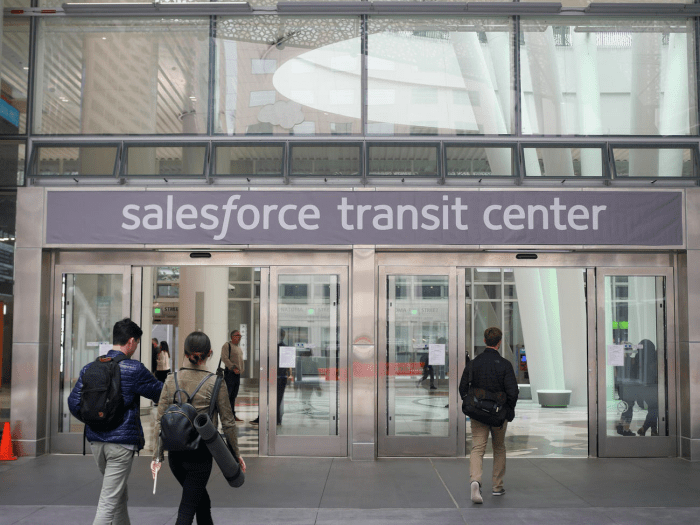 The subject, previously dubbed “integrated transit systems”, (now shortened to “seamless transit”), has been discussed for decades.
Yet, even though Seamless Transit is supported in principle by almost everyone, not much has changed. (The Salesforce Transit Center is an exception, but even there the trains are still missing). The region’s assorted transit systems are mostly just as chopped up and disconnected as ever. Various reasons are advanced for this.
BATWG Critiques Valley Link Draft Environmental Impact Report
For almost a year BATWG has struggled to find the transportation logic behind the frantic effort to push the $3,000,000,000 + Valley Link proposal to the front of the line for federal funding.
Background: Valley Link is a proposed 42-mile commuter rail service with a significant portion to be operated in both directions on a single track. The line would run from the East Dublin BART station via the north edge of Livermore and Tracy to North Lathrop in San Joaquin County. On 9.24.20, $400,000,000 in Alameda County sales tax funds were unaccountably diverted from their voter-approved intent of improving transit connections between BART and the Tri-Valley to the Valley Link proposal (hereinafter VL.)
 On 12.2.20 the Draft Environment Impact Report (DEIR), estimated to be at least 5,000 pages long was finally released, with public comment due by 1.21.21. During the ensuing 40 days BATWG critiqued the document which we believe fails to meet CEQA, Alameda County Measure BB and AB758 requirements in a number of significant ways. Our critiques were submitted to the sponsoring agency before the deadline. Here is part of what we found.
Project Alternatives: CEQA requires that major infrastructure projects include viable alternatives to compare against the “preferred alternative”. Not a single one of the some 30 so-called “alternatives” listed in the DEIR come anywhere close to meeting this CEQA requirement. There were and are other options available. Here are two, either of which could serve local and regional travel needs better than VL would. Both have so far been ignored:
Union City’s Station Specific Plan….Transit-Oriented in Name Only
The City of Union City has just revealed its ambitious 471 acre “Union City Station Specific Plan” in the general vicinity of the Union City BART station. The first chance the public had to learn about the project came at the City’s 2.11.2021 Scoping Meeting.
This venture, like so many others in the Bay Area is being loudly and continuously heralded as “transit-oriented”. The term admittedly has a nice ring to it. That’s because “transit-oriented”, is intended to suggest that placing a housing project near a train station or bus stop would cause people to forsake their cars in favor of less congesting and more environmentally-acceptable means of travel such as bus, train, ferryboat, bicycling and walking. Sounds positive, right?
Here’s the rub:
 Bay Area Transportation Working Group