
In addition to facing the severe ridership attrition created by COVID-19, the Sonoma Marin Area Rail Transit District (SMART) also had to address replacement of their Chief Financial Officer in December 2020 and their long-time General Manager’s retirement in late 2021. With the help of seasoned transit industry executive search experts, two exceptionally well-qualified leaders are now in charge at SMART.
2022
San Jose Mercury, Spur and Bay Council Weigh In

While each of these organizations has its own focus, all seem to agree that major changes in travel habits have occurred and also that how, or if, things will get back to “normal” is far from assured:
Changing Travel Patterns: On February 20, 2022 the San Jose Mercury reminded us of how the popularity of stay-at-home work was cutting into transit ridership. The article focused on COVID’s effects on transit travel which were, and continue to be, devastating. However, something else is going on. It’s more than just changes in commuting. Many types of trips, including auto trips, have been affected by factors other than the pandemic. Zoom meetings are easier and less time-consuming than traveling to public hearings, club get-togethers, advocacy group meetings, business meetings, seminars, workshops and adult education classes. Watching one’s favorite movie at home often beats going to the cinema. And there’s a growing tendency to acquire desired products including well-prepared meals on line rather than driving miles in search of the right retailer. It appears that technology and changes in lifestyle are affecting travel, even as the effects of COVID wane.
Faster, Better, more Cost-Effective
People often wonder how the Bay Area, so full of highly-educated and talented individuals, finds it so difficult to develop cost-effective public infrastructure projects in a timely manner. Some think this is because of corruption. Others say it’s because of incompetence. With excellent input from experts Alan Pisarski, Bent Flyvbjerg and Darlene Gee, HNTB Senior Vice President, BATWG offers a less accusatory set of explanations:
The Projects: Large engineering project are inherently complicated, requiring thousands of planning, design and inter-agency decisions.  As well documented by Bent Flyvbjerg, budget and scheduling problems are common in all large projects throughout the world.
Qualifications: Inexperienced and in some cases unqualified individuals without any training or even orientation are randomly picked to sit on powerful boards and commissions that control millions and sometimes billions of dollars. Insufficiently educated on the importance of their new function, many policy-makers remain confused about regional priorities and overly susceptible to parochial priorities, developers, unions and other outside pressure groups. This sorry practice must end. Qualifications and experience are of critical importance, and every incoming Board member should well understand both the objectives of the new agency and the kinds of decision he or she will be called upon to make. To ensure this result, it is essential that the appointing decisions are made thoughtfully and that incoming new members receive intensive training and orientation.
Independent Foundation Broadsides BART

For anyone interested in how BART spends your tax money,
go to: https://www.independent.org/publications/article.asp?id=13843
and scroll down to News Alerts…
Caltrain Needs Certainty
The governance of Caltrain has been much in the news lately. Given all the talk, one would think that the agency was in a shambles. But it’s not. In fact Caltrain is a well run and well maintained operation that, pre-COVID, was popular with riders and enjoying a steadily increasing ridership.
So why all the hoopla?
MTC, the Caltrain Joint Powers Authority (JPB) and Samtrans, the agency that manages the system for the JPB, have unaccountably squashed four manageable problems into a single highly complex one that they seem unable to address in a calm and dispassionate way, much less resolve.

Let’s take each of the four manageable problems in turn:
SFMTA’s Continuing Muni Metro problems… A Historical Perspective
Back in the 1960’s Muni was part of the SF Public Utilities Commission. In the late 1960’s the oncoming BART subway give Muni an opportunity to modernize its streetcar system. 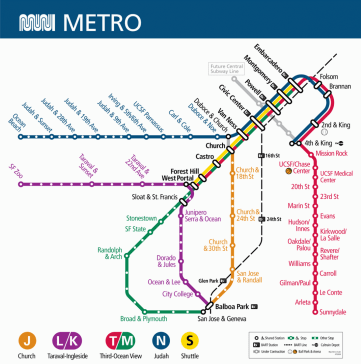 So the PUC sent one of its engineers to Europe to get a better look at some of Europe’s successful subway operations. He returned with a recommendation that there be a single 10-car train extending from State College to the Embarcadero, fed at the West Portal by short K-L trains and at the Duboce Portal by short J-N trains. That recommendation was rejected by the PUC brass on grounds that San Francisco’s streetcar users, used to getting one-seat rides to downtown San Francisco, “didn’t want to transfer and in fact wouldn’t transfer”.
 Bay Area Transportation Working Group