Large Transit Agencies Clamor for New Funding while Ignoring Cost-Cutting Opportunities

Dick Spotswood of the Independent Journal hits it on the head. Here are excerpts from his excellent article on the sad state of current Bay Area transit affairs.

“Raising Bay Area bridge tolls can’t be about preserving transit staff members”

By DICK SPOTSWOOD

PUBLISHED: March 7, 2023 at 10:30 a.m. | UPDATED: March 7, 2023 at 10:36 a.m.

“The Metropolitan Transportation Commission is in the early “talking stage” of creating a 2024 regional ballot measure to raise auto and truck tolls on Bay Area bridges. If this plan moves forward, it will be the fourth measure to raise the cost of transbay commuting. The last one, Regional Measure 3, passed in 2018. A collective majority vote in the nine Bay Area counties is needed for passage.

“The supposed purpose of a potential fourth measure is to aid Bay Area transit agencies who’ve seen declines in patronage and fare-box revenue, in part due to post-pandemic changes on how and where white-collar men and women work.

“Any possible regional measure needs to be followed with an eagle eye. In the worst case, it would create a treasure box of toll revenue ultimately spent in ways only loosely related to their supposed purpose. The next funding package could even include a wildly expensive bike lane of dubious utility on the San Francisco-Oakland Bay Bridge. [Who in his or her right mind would commute 20 to 35 miles a day via a cold, noisy and windy bridge over 20 stories high?]

Continue reading

Caltrain Needs to Pull it All Together

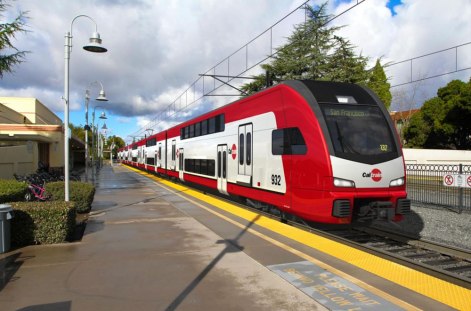
A Stadler Electrified Train

In BATWG’s March 2023 newsletter we noted that given its major capital and new equipment programs in process, its staggering ridership losses, and its large and growing operating deficit, the hardest part of Caltrain’s development program lies ahead. For these reasons it appears that the following actions are needed:

  • get entirely out of the diesel operating business as soon as its new all-electric trains are up and running,
  • take full advantage of other opportunities to cut costs, including cutting service and eliminating or reducing employee categories as necessary,
  • work with other agencies to accommodate those now using Caltrain south of the Diridon Station,
  • benefit from the significant operating advantages of level boarding as soon as possible and
  • interact intensively and effectively with the TJPA right up to the time Caltrain is up and running in the Salesforce Transit Center, as well as with other involved agencies such as the San Jose County VTA and its Diridon Station program.

Subsequently, Caltrain’s Board held a budget workshop on April 6th. Staff and consultants laid out their preliminary budget planning inputs for FY2024 and FY2025 as well as operating and capital cost, ridership and revenue premises for the next ten years. Among their proposals and findings:

Continue reading

Bay Area: Fresh Thinking Needed!

On December 16, 2021 writer, analyst and world-acclaimed transportation consultant Alan Pisarski, in a discussion with BATWG members, suggested five ways in which the transit agencies should alter their programs because of COVID and the resulting societal changes.

From his remarks it was clear that Pisarski thought the dogged determination of some local and regional agencies to proceed assuming that everything would soon “get back to “normal” was most unwise. His recommendations were valid then and remain so today. Here they are:

First he recommended a “moratorium on all expansion-based transportation investment”.

Next, he recommended that the focus be on restoring and modernizing existing systems.

Third, he recommended that a high priority be placed upon determining the long-term impact of the work-at-home trend.

Fourth, he called on the transit agencies to be “responsive to the accessibility needs of lower-income populations”. To this end he encouraged the use of buses, vans and jitneys.

Finally, Mr. Pisarski called for a “strong focus on private sector solutions—utilizing disruptive technologies, capable of responding rapidly to evolving traffic patterns.”

Continue reading

BART’s Very Able Inspector General Leaving

BART has long been recognized as an agency in dire need of independent oversight. In June of 2019, pursuant to State Senator Steve Glazer’s SB1488, Governor Gavin Newsom appointed Harriet Richardson to be BART’s first Inspector General (IG) from among three candidates selected by the BART Board. The job calls for the IG to oversee BART’s finances and report upon any instances of “waste, fraud and abuse”.

harriet-richardsonUnder Ms. Richardson’s able leadership the small IG staff, despite being hindered by the BART staff, Board and Unions, and denied the resources needed to fully cover BART’s vast operation, has been remarkably diligent and successful in identifying and reporting on a large number of inefficient and otherwise improper BART activities. Most of her recommendations have been adopted by BART and some have been put in place.
We are sorry to report that Ms. Richardson has decided not to put her name in the running for reappointment when her four-year term expires in June. It can only be hoped that her successor will be as fiercely independent and effective as she has been.

For Caltrain, More Hard Work to Come

At BATWG’s January 19, 2023, meeting, Clem Tillier was our Special Guest. Mr. Tillier, despite having a full-time hi-tech job, through his volunteer efforts has also managed to become very knowledgeable about the Caltrain operation and its developmental needs. At our meeting he made a number of observations as to what lies ahead for Caltrain. He emphasized the importance of the Caltrain Joint Powers Board (JPB) and staff to begin adapting to Caltrain’s pending new operational and fiscal conditions sooner rather than later.

Caltrain’s nineteen Stadler train sets, each consisting of six EMU’s, will soon begin arriving. While converting from diesel to electric operation may sound like a straightforward transition, it’s not, especially in a time of severe budgetary constraints.

Continue reading

Common Sense Gone Missing

As was graphically pointed out in presentations by MTC, BART, the MTA and Caltrain at a meeting of the SFCTA on February 28, 2023, Bay Area transit systems are having to adapt to greatly reduced post-COVID ridership, escalating operating and development costs and uncertainties over whether or not the generous State and federal subventions of the past will continue. Unfortunately, these problems are occurring at a time when public confidence in the ability of the large transit agencies to operate efficiently and improve their services in an effective manner has declined. So what happened? What went wrong? How can trust in local and regional agencies be re-established?

It appears that a reduction in the quality of daily transit service and the mismanagement of certain large infrastructure projects are at least partly responsible for the problem:

Continue reading