Comments can be sent to any or all of the following individuals:
Jerry Cauthen: cautn1@aol.com
Bob Feinbaum: bobfeinbaum@gmail.com
Michael O’Rourke: transallosf@gmail.com

Comments can be sent to any or all of the following individuals:
Jerry Cauthen: cautn1@aol.com
Bob Feinbaum: bobfeinbaum@gmail.com
Michael O’Rourke: transallosf@gmail.com
Lately there’s been much talk about public transit.
None of these options makes any sense because none deals with the overall problem, which is that there is too much traffic congestion in too many places, coupled with financially floundering transit that doesn’t do as good a job as it does in many other advanced countries.
It’s time to zero in on the actions that would work, and do work elsewhere. Talking endlessly about this or that piece of the problem gets us nowhere.
First, no more expensive studies. The problem has already been studied to death. Excessive congestion can no longer be allowed to ruin cities and other built-up places. Individual cars and trucks traveling in congested areas during congested hours, including computer-dispatched cars, must be tolled. Tolls should be imposed and collected by the affected towns, cities and counties. Toll revenues should go directly into reducing or eliminating fares or otherwise improving the transit alternatives. Not one dollar of the money raised by tolling should be used for any other purpose than improving the non-automotive means of getting around.
As to transit there’s a great deal to do, so it will take time. Here’s a set of priorities that tries to address the subject:
Continue readingSee: https://youtu.be/tJkR7yiQYJY
Please take a few (no more than 8) minutes to watch and learn how the VTA mishandled its BART Subway extension into San Jose. The slides and recording tell an astonishing story of just how dysfunctional a large agency can become. Unless such behavior is challenged at every turn, it will continue unabated. If you want to weigh in write to Board.Secretary@VTA.org and ask that every board member receive a copy of your note. And please pass this message on to your friends.
Unfortunately, large and exotic-sounding transportation projects tend to get far more than their share of attention. As a result, tax funding is often squandered on huge projects instead of being used to advance smaller and more deserving projects.
Take the current situation in San Jose for instance. BATWG recently sent two letters to the Santa Clara Valley Transportation Authority’s (VTA’s) new BART Phase II Steering Committee encouraging it to consider all aspects of the BART Phase II program and indicating a number of important questions of long standing in need of straight answers. Here’s an update:
The last official cost of the VTA’s original twin-bore tunneling option was $4.69 billion, as set forth in the DEIS released in March of 2017. Since the FEIS was released in 2018, the VTA’s cost of first the 43-foot single-bore option and then the 54-foot single bore option has gone from $6.9 billion to $9.1 billion to the current $12.2 billion, an amount that is almost certain to continue to rise.
 It is widely believed that the twin-bore tunnel option would end up being $3 to $5 billion less than the five-story high single-bore tunnel option. Verifying this contention would necessitate a careful and objective re-evaluation of the strengths and weaknesses of both options. Unfortunately, in its habitually insular fashion, the VTA has never seen fit to release a long-promised and long-awaited capital and operating cost comparison of the two options. So at this point, no one knows for sure which option would be less troublesome. Current issues:
Is Caltrain poised to make another big mistake?
Level boarding station platforms speeds things up. BART has level boarding so its riders can enter and leave the trains faster and more safely than if they had to use stairs. This makes it possible for much shorter dwell times at stations and therefore significant time savings for everyone.
Caltrain’s 192 new Stadler electrified cars are equipped to facilitate level boarding. So, when Caltrain’s 2023 and 2024 budgets included allocations directed to getting the level boarding platforms built, people rejoiced, because it was assumed that meant eventual level boarding for everyone. But apparently not. The current plan seems to be that there will be level boarding at only one door per train, to improve wheelchair access. Good handicapped access is fine, but what about everyone else? Instead of action it appears that the Caltrain staff is currently sitting on its collective hands while its spokespeople make excuses. One hears:
“You can’t go to level boarding without shutting down existing train service”. False. Temporary curb-height stations located just south or just north of the construction site would continue to keep the trains running while the new high-level stations were being built.
“There’s not enough money”. There never is, unless an effort is made to find it. The State and federal governments both helped pay to give the Stadler cars the capability of operating with either curb height platforms or level boarding platforms. Chances are they’d look favorably on a request to put this expensive added on-car feature to good use.
Caltrain ridership is now roughly one third of what it was pre-COVID. So, while the trains are shorter, now is the time move ahead with a level boarding construction program. Deferring action would only compound the problem.
In 2022, AC Transit carried a total of 91,565 weekday riders, down from 175,575 weekday riders in 2013. AC Transit operates 131 bus lines. As indicated in the table below, AC’s top 20 lines carried a total of 75,620 riders a weekday. That means that the remaining 111 lines averaged only 144 riders a weekday. This dismal number explains why one constantly sees virtually empty 40 foot and even 80-foot long AC Transit buses lumbering through the streets of the East Bay.
In an effort to address this problem, AC Transit is currently planning a set of route changes scheduled to be implemented next August. Since those managing the rerouting program are too busy to talk to us, here are several BATWG observations, some of which have been made before.
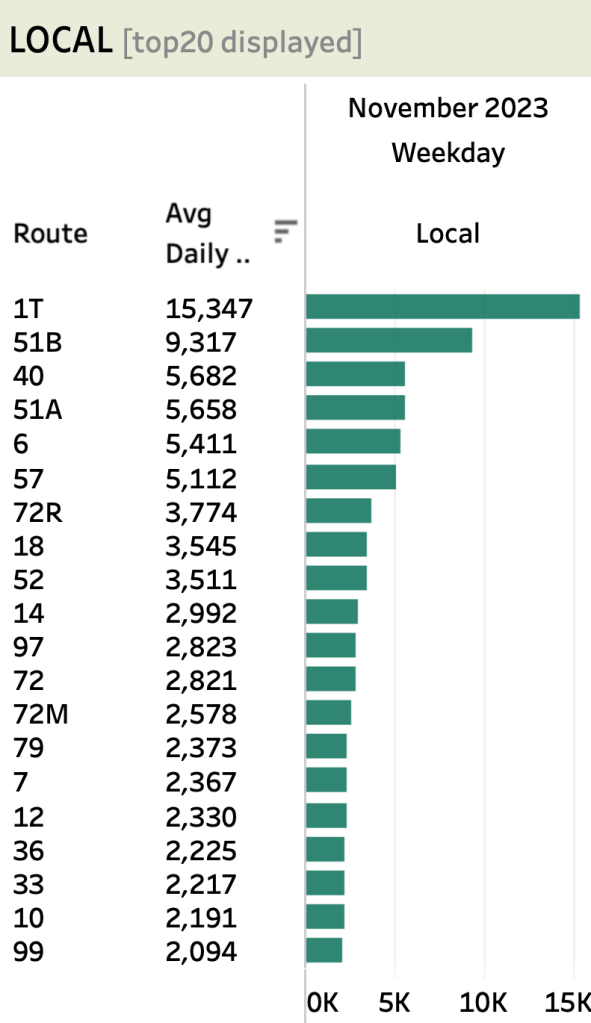
As indicated in the Table, Routes 1T, 51B, 40 and 51A are all carrying a respectable 5,000 riders a day or more. What is it about those five lines that makes them do so much better than the rest of the system? What sets them apart? Those engaged in planning the new route changes should take a very close look at these routes and determine what makes them standouts.
 Bay Area Transportation Working Group