Union City’s Station Specific Plan….Transit-Oriented in Name Only

The City of Union City has just revealed its ambitious 471 acre “Union City Station Specific Plan” in the general vicinity of the Union City BART station. The first chance the public had to learn about the project came at the City’s 2.11.2021 Scoping Meeting.

This venture, like so many others in the Bay Area is being loudly and continuously heralded as “transit-oriented”. The term admittedly has a nice ring to it. That’s because “transit-oriented”, is intended to suggest that placing a housing project near a train station or bus stop would cause people to forsake their cars in favor of less congesting and more environmentally-acceptable means of travel such as bus, train, ferryboat, bicycling and walking. Sounds positive, right?

Here’s the rub:

Continue reading

Advancing Technology Improves Freight Movement Efficiency

Since COVID hit, you may have been pleasantly surprised to see how fast a product ordered through the internet can arrive at your doorstep. Why is that? What’s changed?

The fact is that thanks to a rapidly improving set of internet based, sophisticated computer-control measures, suppliers, forwarders, shippers, and distribution companies are adopting much better ways of keeping track of freight shipments than in the past. One of the benefits of a fast, responsive and efficient internal control system is that rather than having to ship everything from the factory or some other central location, suppliers can now set up and use more local and regional storage centers located closer to demand centers without losing track of their products. This can now be accomplished by sophisticated data analysis used to convert demographic trends, consumption records and advertising “hits” to input data suitable for entry into computer models capable of more closely monitoring freight shipping and storage.

Continue reading

AC Transit’s New Website – a Work in Process

AC Transit’s new website (www.actransit.org) is an improvement. However to make AC Transit’s 158 line network of bus lines more useful to riders and would-be riders, additional work is needed:

Under “About Us”, “Facts and Figures”, there is an easy-to-understand set of graphics showing six measurable indicators of system efficiency and operating effectiveness. Included are On-time Performance, Mean time between Road Calls, Customer Complaints, Weekday Ridership, Annual Ridership and Fare box Recovery. Also needed are Weekday Transbay Ridership, Average 24-hour bus speed, and Operating and Maintenance Cost per Transit Trip.

Unfortunately these charts only go back a few months. It should be possible to see the trends in at least the 7 key indicators shown below for the last one year, five years, ten years and twenty years. Performance measures help gauge the effectiveness of any organization and should be easily accessible from website Home Pages.

Continue reading

O’Rourke Punctures SFMTA’s Subway Balloon

BATWG Newsletter Issue No. 30​

Here is “Citizen/Taxpayer” Michel O’Rourke’s refreshing and painfully accurate response to SFMTA Director Maguire’s uninformed opinion about the Central Subway, as quoted in the SF Chronicle on November 15, 2020:

In an apology for yet another delay of the benighted Central Subway, Mr. Tom Maguire, MUNI director of ‘Sustainable Streets’ gave us the following bromide:

“It is frustrating…” “We made the decision to build the Central Subway long before COVID, and it was the right project, bringing subway service to Chinatown and the most congested part of the city. And it’s still the right project.”

We felt compelled to inform Mr. Maguire that not all of the citizenry share his point of view. As follows:


Greetings Mr. Maguire

Right project? No, Mr. Maguire. I am sorry to disabuse you of fantasy, but is not the right project, it’s the wrong project. Always has been.

Continue reading

Pro-Active Responses to COVID-19 (Elsewhere)

BATWG Newsletter Issue No. 30

The impact that COVID-19 has had on transit and rail service differs widely depending on where in the world you choose to look. Certainly in the United States and Europe transit ridership is down by 70 to 90% but in Asia, after brief but complete shutdowns, it’s near normal. This is largely due to the different approaches used to treat the pandemic. Asian countries like China, Japan, Singapore, Hong Kong, Korea and Taiwan were able to use a very affective test/trace/isolate approach developed from their experience with previous pandemics like SARS, Bird Flu, H1N1 and Ebola. The Western World, but for a few exceptions (Denmark, Germany, Norway), lacked adequate testing, which is not mandatory and has allowed COVID-19 to spread to such a point that tracing is now both more onerous and less useful.

Even now test results of PCR tests still take days to be returned while not covering the whole population.

Continue reading

VTA’s Santa Clara Street Subway Goes Off the Rails

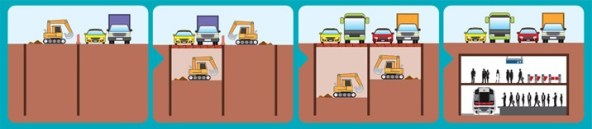
The estimated price of building the 4.8 mile BART extension through San Jose has increased again. It’s now up to $6.86 billion and rising. This all started because of downtown demands that the entire subway be built with no construction impact on Santa Clara Street. This short-sighted demand apparently stemmed from the misguided belief that constructing the two downtown stations using the standard cut-and-cover methods used all over the world for station construction would bring Santa Clara Street to a halt for the entire 4 to 6 year construction period. This is not true. As shown in the section below, at no time would the street be entirely closed. Here’s how it’s normally done.  First, one half the street is excavated and decked over, after which the traffic is shifted to the decked half while the other half of the street is similarly excavated and decked. This phase of the project can be completed in a relatively short amount of time. Once the wooden decking is in place and traffic again flowing, the major below-grade construction work begins. At the end of the job the permanent new roadway is reconstructed, again in a relatively short amount of time and again while keeping at least half the street operating at all times.

Continue reading