
There are rumors that the Santa Clara Valley Transportation Authority (VTA) may finally have come to its senses. As previously reported in these pages (See BATWG Newsletter #14), Phase II of the BART extension along Santa Clara Street through downtown San Jose was to require almost 5 miles of tunnel 56 feet in diameter, the height of a five story building. The subway was also to be exceedingly deep, resulting in longer escalators, longer elevators, longer stairways, longer ventilation structures and longer utility runs. According to a VTA presentation made to the BART Board on May 31, 2019, the bottom of the subway was to be 121 feet below grade, the height of an eleven story building. Needless to add this design added greatly to the project cost.
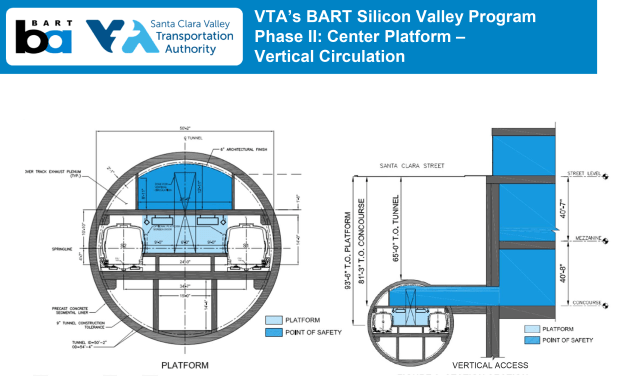
But the situation could be brightening. With a small section of cut-and-cover construction at the two downtown stations the size of the subway could reduced enough to avoid having to haul away an extra 1,400,000 cubic yards of spoil. It would also significantly reduce both the thickness of the concrete tunnel lining and the depth of the subway. It is to be hoped that common sense will eventually prevail in San Jose.
 The Sonoma Marin Area Rail Transit District’s (SMART’s) 45 mile commuter rail service in the North Bay from Santa Rosa to the Larkspur Ferry is funded by a ¼ cent sales tax through 2029. This week North Bay voters decisively rejected the proposal to extend the sales tax for an additional 30 years through 2059, thereby forcing the District to address its budgetary and operational problems in a realistic manner. Past mistakes and unwise decisions regarding cost, scheduling, projected ridership and rail operations have lead to a system that is both excessively costly and underused. Things have gotten to the point where the District’s total operating expense now exceeds its revenue. Fortunately there are 9 years of guaranteed sales tax funding remaining, giving the District sufficient time to reform its management and operations so as to provide a better and more effective service, and thereby improve its standing with the voters.
 There are many good ideas embodied in the report. However the Muni is part of the San Francisco Municipal Transportation Agency (MTA), a complex and multi-layered 6,000 person organization operating in a difficult fishbowl environment subject to virtually continuous public scrutiny. No group of 13, no matter how dedicated, could adequately identify and respond to all the opportunities to improve the functionality of such an organization. For this reason the Mayor’s group was quite dependent upon Muni management for information and therefore took many of its improvement ideas from proposals already in circulation. The Mayor’s effort is ok as far as it goes, but more is needed.
 Bay Area Transportation Working Group