
Central Subway evolved as the product of an insufferable lack of insight, common sense and competence, from beginning to end and top to bottom.
For Willie Brown it was a handshake. He neither knew nor cared how his agreement with Rose Pac would be carried out.
As Mayor, Gavin Newsom let it all happen without knowing or caring about either the outcome or the cost.
For Speaker Pelosi, it was strictly political pork.
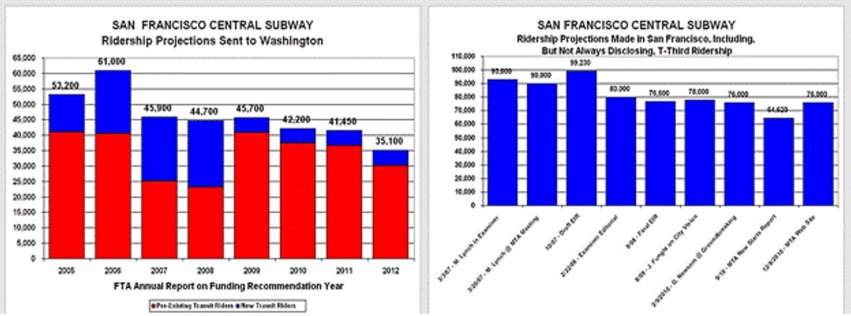
So the project was left to the SF Municipal Transportation Agency (MTA), which gummed things up from start to finish. Back in 2008 and 2009 it began with a big lie. MTA sold its project to the public and elected officials based upon grossly inflated ridership projections and absurdly exaggerated trip time savings, coupled with a real whopper about how the Central Subway was going to save Muni $23.8 million a year in annual operating costs.
 On January 14, 2023 the Bay Area Transportation Working Group (BATWG) sent an open Letter to the BART Board. Here are extracts from that letter; graphics added:
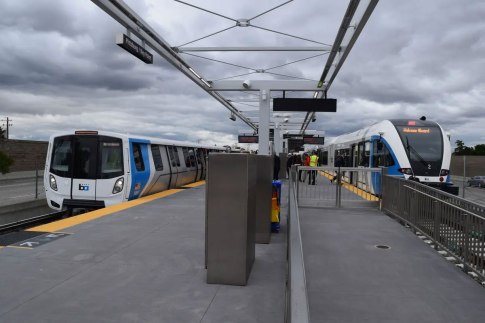 E-BART Extension: BART’s e-BART extension from the Pittsburgh/Bay Point BART terminal to Antioch was completed in 2018. By using Diesel Multiple Units (DMU’s) and existing standard gauge track, BART completed the 10-mile extension at moderate cost. The result is a fast and reliable e-BART service that today links the DMU’s to regular BART trains via a convenient cross-platform transfer. The system was an immediate success, to the point where the size of the access parking lots had to be doubled.
 For these reasons, now would be a good time for the Bay Area’s Transportation Establishment to think about tightening its belt and putting every available dollar to maximum public benefit. To maintain its economic viability the Bay Area continues to need to put a high priority on mobility. People need ways of getting around and it can’t all be by automobile.
 The fact that the project has massively overrun its budget is no longer a secret. What still seems unknown is exactly how the $400 million debt is to get paid off. No matter what the answer turns out to be, it’s the San Francisco taxpayer who going to get burned.
 A case in Point: Waiting for MTC to eventually come up with an all encompassing plan for solving the Region’s connectivity ills is an exercise in futility. Most of what needs to be done could be accomplished better and certainly faster through cooperation and coordination between and among the affected transit agencies, with support from the impacted cities and counties. It bears repeating that riders don’t care a whit about the color of their bus or train, they just want to get there.
 Bay Area Transportation Working Group