
For anyone interested in how BART spends your tax money,
go to: https://www.independent.org/publications/article.asp?id=13843
and scroll down to News Alerts…

For anyone interested in how BART spends your tax money,
go to: https://www.independent.org/publications/article.asp?id=13843
and scroll down to News Alerts…
The governance of Caltrain has been much in the news lately. Given all the talk, one would think that the agency was in a shambles. But it’s not. In fact Caltrain is a well run and well maintained operation that, pre-COVID, was popular with riders and enjoying a steadily increasing ridership.
So why all the hoopla?
MTC, the Caltrain Joint Powers Authority (JPB) and Samtrans, the agency that manages the system for the JPB, have unaccountably squashed four manageable problems into a single highly complex one that they seem unable to address in a calm and dispassionate way, much less resolve.

Let’s take each of the four manageable problems in turn:
Back in the 1960’s Muni was part of the SF Public Utilities Commission. In the late 1960’s the oncoming BART subway give Muni an opportunity to modernize its streetcar system. 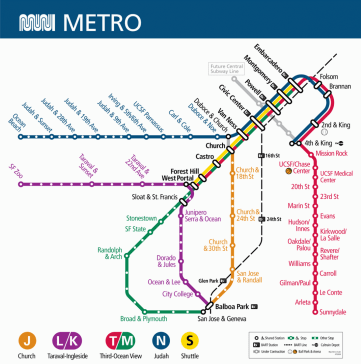 So the PUC sent one of its engineers to Europe to get a better look at some of Europe’s successful subway operations. He returned with a recommendation that there be a single 10-car train extending from State College to the Embarcadero, fed at the West Portal by short K-L trains and at the Duboce Portal by short J-N trains. That recommendation was rejected by the PUC brass on grounds that San Francisco’s streetcar users, used to getting one-seat rides to downtown San Francisco, “didn’t want to transfer and in fact wouldn’t transfer”.
Voters in Sonoma and Marin counties approved a sales tax obligation in 2008 to plan, build and operate the Sonoma Marin Area Rail Transit 70-mile commuter rail system from Cloverdale to about 3/8 mile from the Larkspur Ferry Terminal. The 70 mile plan did not pan out, with SMART beginning 42-mile rail service from Santa Rosa to San Rafael in mid-1917, and extending to Larkspur in late 2019.
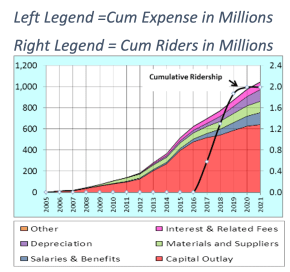
As of Dec 2021, the cumulative cost to build, operate, and finance SMART totaled $1 Billion while the cumulative total ridership was approximately 2 million one-way passenger trips. That works out to about $500 for every one-way passenger trip, so far!
Every transit operator reports data monthly and annually to the National Transit Database (NTD) maintained by the Federal Transit Administration. The NTD data is the source for uniformly reported statistics on operating expenses, passenger trips and passenger miles, fare revenues and the number of vehicle miles and hours of service provided. Below is the history for SMART.
1 University of Oxford, Oxford, UK 2 IT University of Copenhagen, Copenhagen, Denmark
Bent Flyvbjerg is among the world’s foremost analysts of public project planning and management shortcomings. His research shows persuasively that there are multiple, repeated behaviors that have consistently resulted in high public works project cost overruns, demand estimate shortfalls and benefit overstatements. He has compiled a comprehensive history of over 2,000 projects on which he bases his findings and conclusions.
 On November 15th the MTC Fare Integration Task Force (Task Force) adopted a fare integration statement to help Bay Area transit agencies deliver a fairer and better-coordinated fare collection system for the Bay Area.
 Bay Area Transportation Working Group