
Central Subway evolved as the product of an insufferable lack of insight, common sense and competence, from beginning to end and top to bottom.
For Willie Brown it was a handshake. He neither knew nor cared how his agreement with Rose Pac would be carried out.
As Mayor, Gavin Newsom let it all happen without knowing or caring about either the outcome or the cost.
For Speaker Pelosi, it was strictly political pork.
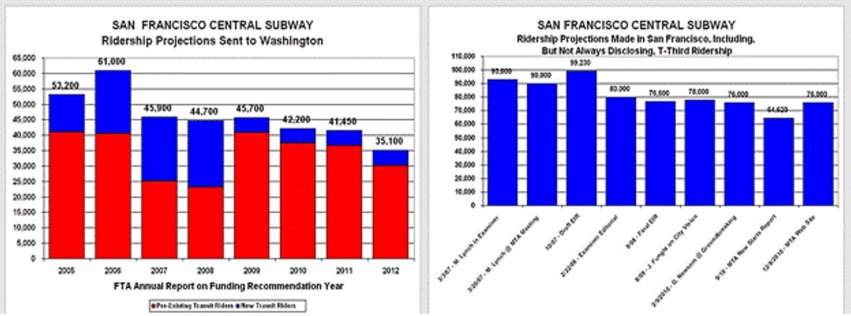
So the project was left to the SF Municipal Transportation Agency (MTA), which gummed things up from start to finish. Back in 2008 and 2009 it began with a big lie. MTA sold its project to the public and elected officials based upon grossly inflated ridership projections and absurdly exaggerated trip time savings, coupled with a real whopper about how the Central Subway was going to save Muni $23.8 million a year in annual operating costs.
Read More Here
By then the project was on autopilot. No one at the MTA thought about or concerned himself about the practicality of the project, its costs, or even of alternative ways of proceeding. And no consideration was given to warnings set forth in three independent analyses of the project, or the Federal Transportation Administration’s Project Oversight Consultant or the anguished testimony of many other informed parties. To make matters worse the MTA’s control over its designers, suppliers and construction contractors was consistently weak and ineffectual, which added years of delay and hundreds of millions of dollars to the cost.
The 1.3 mile long Central Subway began commercial operations on January 7, 2023, four years late and $400 million over budget. The rosy early ridership projections which ranged from 64,430 to 99,220 one-way riders a day have plummeted. During its first three weeks of operation the four Central Subway generated a total of just 3,800 boardings a day from its four stations.
Unfortunately, MTA’s general incompetence, coupled with arrogance, insularity and a steadfast lack of transparency created the sorry-ass result that has now been inflicted on SF and the taxpayers. The MTA simply didn’t have enough smart, experienced people on board to either think the problem through rationally or run the job properly; and the independent oversight that should have come from local and regional officials was noticeably lacking.
As a result, San Francisco has been saddled with a project that is both of little transportation value and incredibly wasteful of taxpayer dollars. Its only benefit may be as a lesson on what not to do when planning, designing, funding and building major infrastructure projects.
 Bay Area Transportation Working Group
Rose Pak spelled her name with a ‘k’ — not a ‘c’.
Also the passage “3,800 boardings a day (equivalent to 7,600 one way riders a day)” doesn’t make sense. Aren’t boardings and one-way rides the same thing? So 3,800 round-trips would be equivalent to 7,600 one-way rides.
LikeLike
The problem is not that the line was built but that it was not extended far enough north to make sense. The Northeast part of San Francisco is one of the densest areas in North America, with surface transit necessarily being slow, inefficient and unattractive to riders. However, building a subway that extends only partially into that area, with the terminus station one stop from Market Street makes no sense. The subway tunnel actually goes farther North to Washington Square. Putting a station there would turn the subway into a very well-used and functional service. Extending it one more stop to Fisherman’s Wharf would be even better.
Steve,
I agree that extending the line to Washington Square and Fisherman’s Wharf would add benefits, but most of us feel that by not providing efficient connections to Market Street and being so deep at Union Square and in Chinatown, the existing line caused many would-be riders to either walk or stick to their buses.
Unless and until a vibrant downtown and the Conventions come back, it probably doesn’t matter. People no longer feel safe in San Francisco (or my city of Oakland for that matter).
Jerry Cauthen
LikeLike