
It is generally agreed that the world has been warming and that this has caused the melting of ice and, according to the EPA about 9 inches of sea level rise since 1880. There is also agreement that there is more man-caused greenhouse gas in the atmosphere than there used to be. And that’s about where the agreement ends.

The nature of the climate debate has shifted. There are now at least four ways of looking at the situation.
Read more here:
Group One: This group says that since we’re coming out of a little ice age the world is warming and will probably continue to warm no matter what mankind tries to do to affect the climate. This group is therefore committed to spending whatever is necessary to get ready for and combat continued sea level rise, methane releases, weather swings, food supply disruptions, public health impacts and migration away from uninhabitable areas.
Group Two: Led by Former Vice President Al Gore, Climate Enthusiast Greta Thumberg, World Economic Forum Czar Klaus Schwab, Special Climate Envoy John Kerry and Congressperson Alexandria Ocasio Cortez, this group is convinced that global warming is caused by human GHG emissions, is an existential threat to the planet and that the consequences of doing nothing to rid the world of all fossil fuel consumption by 2050 would be catastrophic.
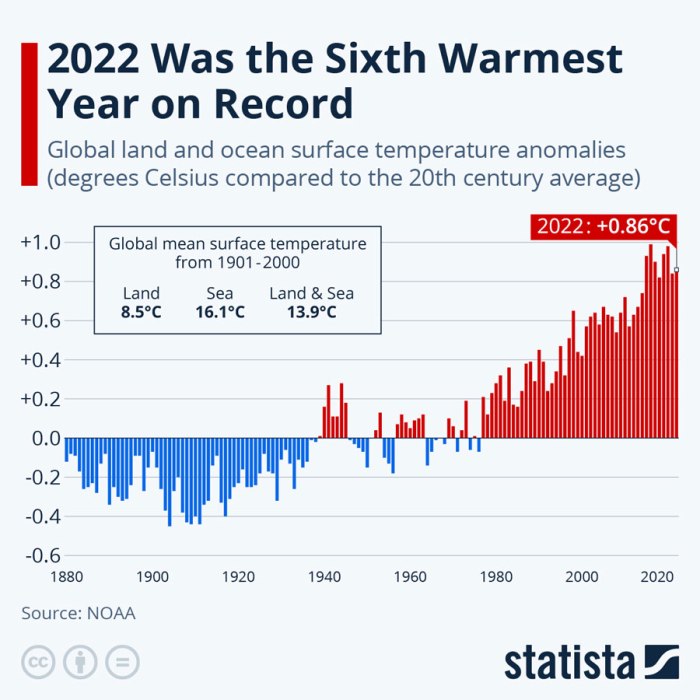
This chart shows temperatures as being the warmest on Record. Unfortunately the “record” goes back only to 1880. From 1880 to 2022 the chart shows the temperature as having risen an average of 0.1 degree Celsius per decade. If this rate of increase continues it would mean that a century from now the world would be 1 degree Celsius warmer than it is today.
Group Three: This group agrees that man caused fossil fuel burning could possibly be affecting the climate (although to an unknown degree) but insists that for a host of reasons, the crash program favored by Klaus Schwab’s “World Economic Forum” is not justified by the data contained in the reports of the Intergovernmental Panel on Climate Change (IPCC) and that phasing out all fossil fuels by 2050 would cost tens of trillions of dollars, far more than was previously revealed. And further, that no matter what is done and how much it costs, it would not be possible to rid the world of fossil fuel consumption soon enough to stave off further temperature rises. This means that in addition to the tens of trillions of dollars required to turn the energy systems of the world upside down in a brutally short period of time, it would be necessary to spend additional tens of trillions responding to the continued effects of some global warming.
Group Four: This group, incessantly passed off as “climate deniers”, believes that climate and global temperatures are affected by many factors having nothing to do with human activity and that the planet has always been warming or cooling. They therefore conclude that while there is reason to do whatever mankind can do to slow or stop the warming, care must be taken to avoid making things worse in the process. Groups 3 and 4 are therefore focused on what appears to be a much more measured and practical way of addressing what could be a very serious oncoming problem.
It follows that none of the beliefs of the four groups can be ignored. However, it has become apparent that if things proceed on their present chaotic course as promoted by the World Economic Forum, the Saudi’s and others seeking to profit from the currently heavily promoted crash, the resulting destruction could prove to be as great or greater than the warming itself.
Getting Serious about Solutions: To date there has been much talk but little progress on the world-wide actions that it would take to materially affect the amount of CO2 in the atmosphere, much less the climate of the world. The best chance of avoiding climate catastrophe without causing human catastrophe in the process lies with human ingenuity and adaptability. There are already efforts underway to address the problem in a more practical and measured way. Here are some of the possibilities:
- instituting a massive tree planting program.
- Bringing large and/or small nuclear power plants online asap.
- reflecting more of the sun’s energy through cloud seeding.
- sequestering greenhouse gases below ground.
- Building lighter and better batteries.
- Lowering or eliminating the fossil fuel requirements of cars, trucks, airplanes, machinery of all kinds and, where practical, heating systems as well.
- developing replacements for the natural gas now used to create fertilizer.
- finding replacements for the costly and hard-to-obtain materials currently needed for solar panels, wind turbines and batteries.
Here are some immediate actions that the “elites” in the advanced countries could take to get things going:
- Increase taxes on jet fuels tenfold.
- Triple the taxes on other fossil fuels.
- Toll highway use.
- Enact congestion pricing wherever necessary.
- Replace fly-around-the-world climate meetings with zoom meetings.
First and foremost, government and business leaders could set a good example by significantly reducing their own excessive fossil fuel consumption.
Complicating Technical Factors: Here is a sampling of why addressing the climate problem is so much more complicated than is being portrayed:
a.) The total amount of energy now produced by wind and solar amounts to just 16% of the world’s energy consumption and the cost of expanding these sustainable sources is getting more difficult and costly by the month.
b.) Nuclear energy would be a far cleaner and safer way of providing energy than coal and other fossil fuels but it’s expensive to put in place, and it’s controversial because of three past incidents. The fact that France has been 75% nuclear for at least the last 45 years without incident and is now building 14 new plants should give confidence that nuclear power plants have gotten a lot safer and better since Chernobyl.
c.) Everyone wants to enjoy the benefits of energy. Therefore, the world-wide demand for it will continue to increase no matter what is done. Because of this increasing demand, the consumption of fossil fuel energy will continue to rise. Cutting off the supply or letting fuel get too expensive would be devastating for at least half the world’s population.
d.) Because of the scarcity and increasing costs of relatively clean fuels such as oil and natural gas, many parts of the world are going back to the burning of coal, a much dirtier fuel with a far worse impact on public health.
e.) Wind and solar are projected to require twice as much copper as the world now produces. To obtain one ton of copper requires that 400 tons of copper ore be excavated, hauled to the copper smelting plant and later disposed of. It takes a great deal of fossil fuel energy to mine and smelt copper. 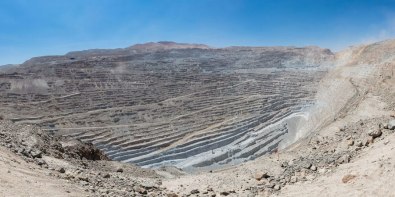 Here’s what a gigantic open pit copper mine looks like. Hundreds of additional such mines would be needed to meet the anticipated increased demand for copper and other rare metals. If past experience is any guide, it would be difficult to obtain regulatory and environmental approval of such mines. According to climate economic expert Mark Mills, even with approval it normally takes 10 to 15 years to bring a huge open pit mine online.
Batteries, solar panels and wind turbines require many other elements and minerals that are also in short supply including cobalt, nickel, lithium, tungsten, zink, manganese and the rare earths. As demand for these difficult-to-obtain materials rises, their costs are expected to also increase significantly.
 Bay Area Transportation Working Group
I’ll believe global warming is a problem when the rich people telling me it is a problem start acting like it’s a problem. They can start by getting rid of their carbon-spewing private jets.
LikeLike
You probably noticed that we recommended increasing the tax on jet fuel ten fold and calling on the elites to begin the program by cutting down on their excessive use of energy..
LikeLike
Well, I don’t want to throw the baby out with the bath water. While I don’t mind sticking it to the rich hypocrites, we should not punish the typical air traveler who flies commercial to visit friends/relatives or take a vacation. We need a more nuanced solution. Maybe exempt the airlines?
LikeLike
Exempting the airlines, or at least reducing the rate for them is a possibility. However, a tax on jet fuel wouldn’t fall as heavily on the hundreds of flyers on a commercial jet as it would on the hotshots who flit around in their own private jets. Assuming for the moment that fossil fuel consumption really is the cause of global warming, a legitimate response has to start somewhere. Neither hydrogen vehicles, nor battery powered vehicles, nor wind nor solar nor or all of them together are addressing the problem in a serious way.
LikeLike
Well, see my first post. Nobody actually believes we are all going to fry because of global warming. If they did believe it, they would get rid of their private jets and waterfront mansions voluntarily.
LikeLike
If everyone takes that view, and man-caused global warming turns out to be a gigantic hoax then everyone wins.
LikeLike
The key phrase is “man-caused.” The climate has been changing forever.
SUVs did not cause glaciers to melt at the end of the last ice age.
But, for the sake of argument, let us stipulate that there is actually “man-caused global warming.” If the USA shut down modern life and lived like the Amish, it would not do squat because China and India won’t slow down.
LikeLike
Agreed, it doesn’t much matter what the US does, although since the rich countries are producing most of the greenhouse gases, one might expect them to do more than the impoverished half the world whose per capita energy use is tiny, because wood and dung are still all they have for cooking and staying warm. One reassuring fact is that based upon the current rate of average temperature increase, a century from now it will have risen just 1.8 degrees Fahrenheit.
It is estimated that the sea level has been 130 meters lower than it is now….in part because as more and more ice formed it reflected more and more of the sun’s energy. One hundred and thirty thousand years ago the sea level was 8 meters higher than it is now. In the distant past the charts show the sea level as having risen to far greater heights. Luckily there are mountains.
LikeLike