
On December 19, 2023 the SF Chronicle, in an article by Nora Mishanec, shined the spotlight on the failings of SF’s City Government’s much ballyhooed Vision Zero program.
The program was instituted in 2013 with the objective of reducing the traffic fatalities in San Francisco to zero “within a decade”. Well, here we are 10 years later, and the traffic fatality rate remains pretty much as it did before the program was initiated.
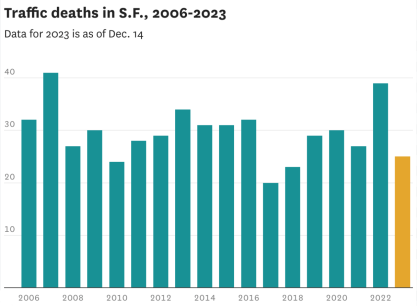
Read More Here
According to the Chronicle, to achieve this objective, the SFMTA has spent $70 to $80 million a year, most of which has gone into making expensive physical changes to San Francisco streets. Some changes have helped, some have had little effect and quite a few have actually made things worse. In any event there has been little if any progress toward fulfilling the objective of the program.
So what’s missing? There are several possible causes of the continuing problem. For one thing there’s been a shocking decrease in the number of traffic citations issued, as shown in the Chronicle’s chart below:
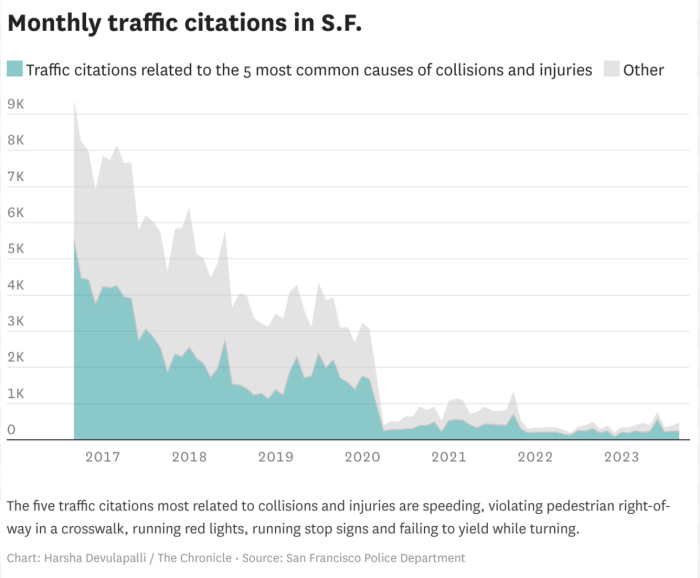
Between 2017 and 2023 the number of traffic citations issued for the traffic violations most responsible for the collisions and the injuries dropped by an inexcusable 96%. To cut down on traffic accidents there have to be consequences for law breaking.
For another, it is time to take a close and objective look at the effectiveness of the MTA’s ongoing street “improvement” program. Bicycle lanes are often placed immediately adjacent to fast traffic. Is this a good idea? If the bicycle lane is to the right of the traffic, cars turning right must watch for other traffic, traffic signals, pedestrians, and bicycles approaching from behind. If the lane is to the left, motorists turning left face the same problem. As to bicyclists, one often sees them making their turns by darting across several lanes of moving traffic.
In part to reduce traffic accidents, there should, for sure, be less driving in congested cities like San Francisco. But there are ways of reducing congestion that neither endanger people nor unduly constrict roadways.
And finally, there’s attitude. People are impatient, and some are flagrant scofflaws. Yet elsewhere in the world, one comes across cities where peds, cars, trucks, buses, motorcyclists, bicyclists and circus clowns amiably share space on crowded city streets with few conflicts where accidents are rare. That’s largely because the travelers, whatever their mode, are patient and attentive to the whereabouts and needs of other travelers. It’s a model that travelers in San Francisco would do well to emulate.

