SFMTA Continues to Duck Questions about the Siemens Couplers

San Francisco’s Muni Metro Subway was designed to accommodate four and five car trains. Since the 1997 introduction of new BREDA LRVs and the Automated Train Control System (ATCS), the Muni and now the SFMTA have refused to operate with more than two car trains, thereby reducing the carrying capacity of the subway and adjoining Twin Peaks and Sunset Tunnels to less than half their design capacity.

To be able to form at least three and four car trains the MTA would need to restore its previous ability to couple trains together at the West and Duboce portals. It was anticipated that with the incoming Siemen’s LRVs this essential capability would be possible. Last Fall BATWG, Save Muni and others began asking the MTA whether or not the new Siemens couplers had this capability. However, since the arrival and testing of 68 new Siemen’s LRVs, no attempt has been made to either answer our questions or demonstrate this capability.
VTA’s Subway Extension Goes Off the Rails

Certain San Jose business interests, apparently in reaction to the Market Street subway construction program of yesteryear, have been stridently demanding that the San Jose subway be entirely tunneled, even at stations. These demands have radically increased the costs and risks of the project.

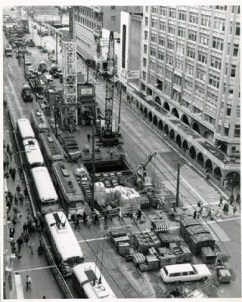
Maybe San Jose’s business people don’t know that despite the fact that all four of BART’s downtown stations were to be built by cut-and-cover methods, the City of San Francisco (City Hall) insisted that BART keep the City’s active streetcar lines in full operation throughout the subway construction period.
This decision made it necessary for the contractors to “shoofly” (shift) the streetcar tracks a total of 8 times:  1. eastbound track to the south edge of street and westbound track to north edge, 2. then both tracks on north edge, 3. then both on south edge, 4. then both back to the center….a process that was repeated at the end of the job. This added greatly to the time and cost of building the subway and also caused a significant amount of unnecessary construction disruption. But there are no streetcars on Santa Clara Street.

Continue reading

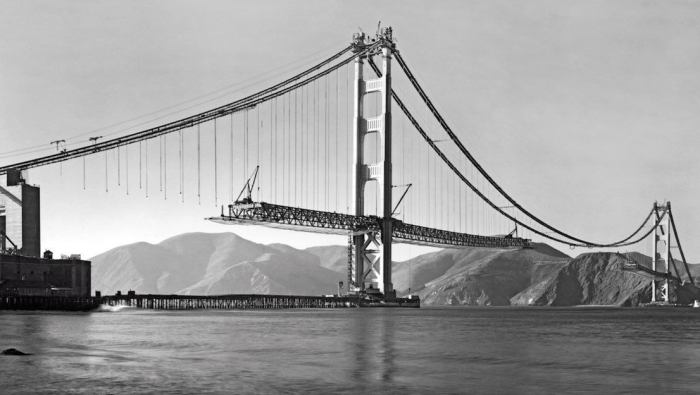
Golden Gate Bridge, Highway & Transportation District: Rich in Transportation History & Innovation

The Golden Gate Golden Gate Bridge, Highway and Transportation District [GGBHTD] was born in 1969 with Assembly Bill 584 authorization and the Golden Gate Ferry service between San Francisco and Sausalito launched in August, 1070. This was followed by the Golden Gate Transit bus service which began operations in 1972.

The GGBHTD has an impressive history of innovation and effective leadership. Under Bridge Board direction, the District is currently managed by Denis Mulligan. Mr. Mulligan was the District’s Chief Engineer from 2001 to 2010 and since 2010 has been its General Manager. Among the District’s many noteworthy accomplishments are the following:

Continue reading

Quote of the Month

At the May 5/6 National Shared Mobility Summit, SFMTA Transportation Director Jeff Tumlin was quoted as saying: “This (sic…meaning the pandemic) is a once-in-a-lifetime opportunity to question all of the historic, political decisions that created the transit system, in the form that it was when we inherited it.”

Could he actually have said that? Could he have failed to learn how and under what circumstances transit evolved? Or how and why its decline began after WWII. Or why it continues to have appeal for urbanites and environmentalists? Has he never seen or read about the great systems of many European and Japanese cities?

Mr. Tumlin should forget trying to psychoanalyze the politicians and instead focus on making his system work better.

Streamlining the Caltrain Extension Project

Bay Area Transportation Working Group

During these difficult times of shutdowns and reduced resources, it is both necessary and prudent to conserve transit resources wherever and whenever possible.

With that in mind the Bay Area Transportation Working Group (BATWG) has updated its previous statements about the DTX project. There appear to be opportunities to significantly reduce costs without cutting into or otherwise undermining the passenger rail service into the Sales Force Transit Center. We are joined in these recommendations by the two preeminent rail advocacy organizations of California; namely, RailPAC and the Train Riders Association of California as well as by TRANSDEF, SaveMuni and other DTX supporters. These opportunities relate to the 4th and King Station, the proposed Pennsylvania Avenue subway extension, the Tunnel Plug and the subway under Second Street:

Continue reading

Getting the Phase II BART Extension Right

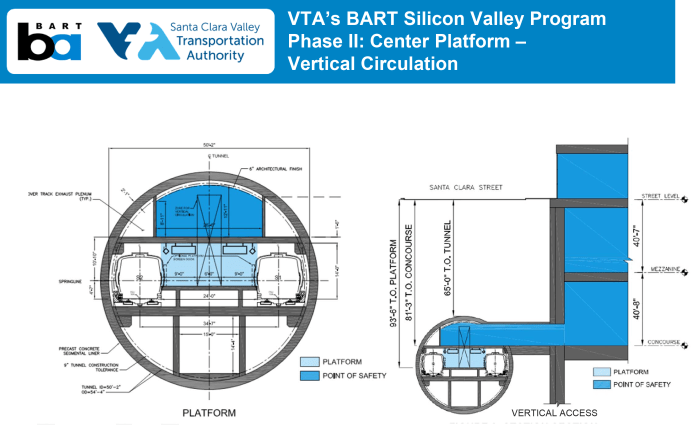
There are rumors that the Santa Clara Valley Transportation Authority (VTA) may finally have come to its senses. As previously reported in these pages (See BATWG Newsletter #14), Phase II of the BART extension along Santa Clara Street through downtown San Jose was to require almost 5 miles of tunnel 56 feet in diameter, the height of a five story building. The subway was also to be exceedingly deep, resulting in longer escalators, longer elevators, longer stairways, longer ventilation structures and longer utility runs. According to a VTA presentation made to the BART Board on May 31, 2019, the bottom of the subway was to be 121 feet below grade, the height of an eleven story building. Needless to add this design added greatly to the project cost.

But the situation could be brightening. With a small section of cut-and-cover construction at the two downtown stations the size of the subway could reduced enough to avoid having to haul away an extra 1,400,000 cubic yards of spoil. It would also significantly reduce both the thickness of the concrete tunnel lining and the depth of the subway. It is to be hoped that common sense will eventually prevail in San Jose.