The imbalance in Bay Area transportation has reached monumental proportions Today’s over-reliance on the private automobile has slowed things down to a creep. The following 10 actions are part of what’s needed to bring regional travel back into balance:
1.) Upgrading and extending Caltrain into San Francisco’s new Transbay Transit Center (TTC) should be the Region’s No. 1 transportation priority. The TTC is located near roughly 400,000 downtown jobs and adjacent to at least 25,000 new transit-oriented housing units. By linking the new Transit Center to Market Street via subsurface moving pedestrian ramps the extended line will connect Caltrain directly to nine BART and Muni Metro subway lines and the Muni’s F Line running on the surface of Market Street. The extension will also connect Caltrain and eventually high-speed, long-distance trains to over 40 bus lines. Taken all together this new nexus of public transit services will create countless new connection opportunities for Bay Area travelers.
2.) To connect parts of the Region not well served by BART, there should be a Regional Bus System, operating on transit-only lanes wherever and whenever necessary to guarantee expeditious and reliable service. Passenger rail and bus lines should be carefully and thoroughly integrated to form a seamless network for the benefit of all transit users.
3.) An early action project should be to develop a rail shuttle system between the East and West Bay via a rebuilt Dumbarton rail bridge.
To ease crowding on BART and traffic backups on Highways I-580, I-680, I-238, I-880, 84 and 92, the ultimate plan should be to double the current average speed up the Altamont Commuter Rail Service (ACE) trains between Stockton and San Jose and to extend an ACE branch line via the rebuilt Bridge and Caltrain tracks to San Francisco’s Fourth and King Street Caltrain station.
4.) To ease pressures on I-80, a transfer station between the Capitol Corridor service and BART should be constructed in West Oakland. To improve passenger rail connections between Auburn and San Jose the Capitol Corridor line should be significantly upgraded, as proposed by the Capitol Corridor Joint Powers Authority and BART.
5.) AC Transit’s currently anemic ridership should least double. This can be accomplished by better routing, transit-only lanes where and as needed, better signing, better maps, a more user-friendly fare structure and….once the improvements are underway….an effective marketing program. It is anticipated that absence a major economic collapse BART will run out of transbay carrying capacity sometime between 2025 and 2030. For this reason and because it will many decades before the much heralded second transbay rail service will be up and running, it is especially important that AC Transit adjust its routes and take such other actions as are needed to attract and serve a greatly increased transbay ridership.
6.) Today’s Santa Clara Valley Transportation Authority’s light rail system is widely regarded as the worst in the entire country. As a result it is currently carrying about 25% of the riders it should be serving. Instead of extending a system with a rotten core, the focus should be on fixing the core. Steps should be taken to speed up and straighten out the grotesquely distorted routing along the existing Guadalupe and Vasona Lines.
7.) Today’s Bay Area transit vehicles loaded with passengers are often bogged down in traffic congestion. In response to this worsening problem, successive generations of elected politicians have talked the talk but failed to walk the walk. As a result, millions of harried transit riders continue experience both unacceptable urban congestion and brutal highway backups. A concerted effort should be made to make certain that the obstacles to consistently reliable and expeditious train and bus service are removed. Where and when necessary, congestion pricing and/or highway tolls should be imposed to discourage excessive automobile use in highly congested areas. Good transit service is an essential element of travel mobility. Travelers who’ve opted to ride collectively on trains and buses deserve priority on highways and city streets.
8.) Public projects are no longer subjected to rigorous cost-effectiveness scrutiny. Nor is financial feasibility any longer given the priority it deserves. This slipshod practice has resulted in many ill-conceived and poorly executed transportation projects and the waste of tens of billions of scarce transportation dollars. Before advancing a capital improvement proposal, its cost-effectiveness, financial feasibility and future operating effectiveness should be independently verified. The results of these analyses should be published. Before advancing a favored capital improvement proposal, an objective analysis of the potentially viable alternatives should be conducted. The results of this analysis should also be published.
9.) Regional land use and transportation programs and funding packages that encourage more Bay Area automobile use should be scrapped. Automobile travel is and will remain an important element of Bay Area travel. However things have gotten out of hand. No one benefits from gridlock.
10.) BART is the Bay Area’s transportation work horse. Its existing system has long needed major improvements, including seismic upgrading, better vehicle and rail maintenance, a greater emphasis on the replacement of aging vehicles, sound walls at noisy stations, automatic train control improvements and, last but not least, a solution to BART’s looming trans-bay capacity problem. The efficiency and effectiveness of BART’s existing system should henceforth be put before politically-driven expansion schemes.

 Most impressively, the 10-mile extension including vehicles was completed at a per mile cost of less than one sixth the estimated cost of building the much ballyhooed all-BART extension to Livermore.
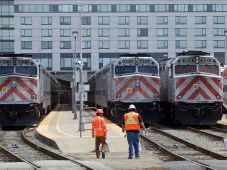 Yet for the last 40 months the multi-agency Rail Alignment and Benefits (RAB) study has unnecessarily delayed and obstructed DTX. And the disruption is continuing. The May 29, 2018 RAB release continues to place extra costs and other obstacles in front of DTX. Here are some ways of accelerating the process:
 In 1963 the voters of the three original BART Counties; namely Alameda, San Francisco and Contra Costa, formed the BART District and have been paying taxes into the system ever since.
 Bay Area Transportation Working Group