
BART has long been recognized as an agency in dire need of independent oversight. In June of 2019, pursuant to State Senator Steve Glazer’s SB1488, Governor Gavin Newsom appointed Harriet Richardson to be BART’s first Inspector General (IG) from among three candidates selected by the BART Board. The job calls for the IG to oversee BART’s finances and report upon any instances of “waste, fraud and abuse”.
 Under Ms. Richardson’s able leadership the small IG staff, despite being hindered by the BART staff, Board and Unions, and denied the resources needed to fully cover BART’s vast operation, has been remarkably diligent and successful in identifying and reporting on a large number of inefficient and otherwise improper BART activities. Most of her recommendations have been adopted by BART and some have been put in place.
We are sorry to report that Ms. Richardson has decided not to put her name in the running for reappointment when her four-year term expires in June. It can only be hoped that her successor will be as fiercely independent and effective as she has been.
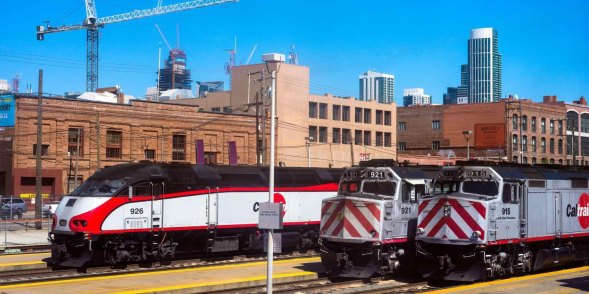
 It appears that a reduction in the quality of daily transit service and the mismanagement of certain large infrastructure projects are at least partly responsible for the problem: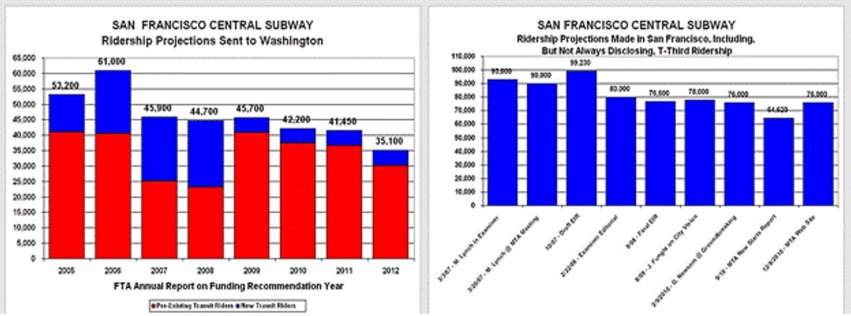
 On January 14, 2023 the Bay Area Transportation Working Group (BATWG) sent an open Letter to the BART Board. Here are extracts from that letter; graphics added:
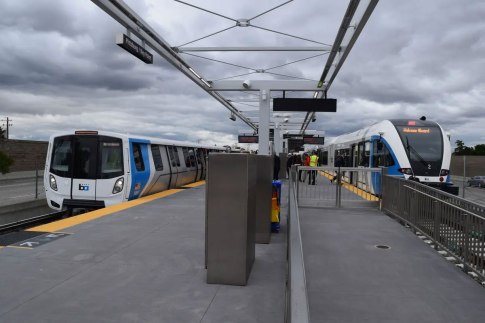 E-BART Extension: BART’s e-BART extension from the Pittsburgh/Bay Point BART terminal to Antioch was completed in 2018. By using Diesel Multiple Units (DMU’s) and existing standard gauge track, BART completed the 10-mile extension at moderate cost. The result is a fast and reliable e-BART service that today links the DMU’s to regular BART trains via a convenient cross-platform transfer. The system was an immediate success, to the point where the size of the access parking lots had to be doubled.
 Bay Area Transportation Working Group