
Over the last 30 years, much of what has been ballyhooed in the Bay Area as transportation capital improvement has turned out to be special-interest/ pet parochial projects of small consequence and highway expansions accommodating increased Bay Area traffic.
 For this reason, when something positive occurs it deserves recognition. On November 6, 2018, the voters of San Mateo County approved Measure W which, through a ½ % county sales tax increase, will provide about $40 million a year to pay for various for improvements to the San Mateo County Transportation Agency (SamTrans). Along with Caltrain, SamTrans buses provide transit service throughout the Peninsula as well as north-south connections between Santa Clara County, San Mateo County and San Francisco County.
On August 23, 2019 SF Examiner reporter Joe Rodriquez summarized some interesting new steps that SanTrans is taking to make its service more visible and more relevant to riders and would-be riders in the West Bay.
SamTrans’s actions are focused on meeting six simple but practical objectives; namely:
Provide Mobility Options for Regional Trips
Increase Market Share in Corridor
Develop a Cost-Effective System
Improve Transportation Equity
Enhance Access to Jobs and Population Centers
Support Sustainable Land Use and Transportation Policies
As part of its program for increasing market share, SamTrans is seeking to attract both more reverse direction riders during peak commute hours, and more off-peak riders.
 Yet the Center’s vast underground train levels sit bleak and empty awaiting the arrival of passenger trains to link Silicon Valley, the San Mateo Peninsula and downtown San Francisco. Recently, thanks in large part to conflicts among various elements of San Francisco’s government, the Caltrain extension project (DTX) appears to have once again ground to a halt.
 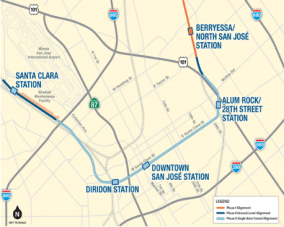 The following critique responds to the presentation made to the BART & VTA “Special Committee” meeting at BART’s Oakland Headquarters on May 31, 2019. Santa Clara Valley Transportation Authority (VTA) is proceeding with its 16 mile long, two-phased extension of BART from the current Warms Springs terminal through San Jose to a future terminal station in Santa Clara. Phase I, covering the first 10 miles of the project will be constructed mostly on viaduct and include the Milpitas and Berryessa Stations. Phase II will proceed from Berryessa for six miles in mostly subway and include the Alum Rock, Downtown San Jose, Diridon and Santa Clara stations. Phase II is where things really get expensive. According to the EIR, the total cost of Phase II is projected to be $4.7 billion. It is anticipated that bottom of the tunnel extending for five of the six miles of this phase will be 121 feet below street grade (equivalent to the height of a twelve story building) and that the tunnel hole needed for the entire 5 miles will be 55 feet 10 inches in diameter. This raises several important questions:
  Bay Area Transportation Working Group