
Connecting the 78-mile long Caltrain line via a 1.3 mile extension to the nine Muni and BART subway lines, the Market streetcars and dozens of bus lines in downtown San Francisco has been a San Francisco transportation objective for over 40 years. In 1999 the voters of San Francisco approved the idea by an overwhelming 69.3%. Since then tens of thousands of new transit-oriented housing units and 19 major highrise buildings either already exist or are under development in the immediate vicinity of the new Salesforce Transit Center.
 Yet the Center’s vast underground train levels sit bleak and empty awaiting the arrival of passenger trains to link Silicon Valley, the San Mateo Peninsula and downtown San Francisco. Recently, thanks in large part to conflicts among various elements of San Francisco’s government, the Caltrain extension project (DTX) appears to have once again ground to a halt. Continue reading
 Since the Plan is still in its earliest stages, the presentation was limited mostly to a description of the Region’s existing transportation problems and the Plan’s strategic, outreach and funding goals and objectives. As Mr. Baker of the SVLG put it, “…..we think the time is ripe to work for a world class, more integrated transit system that is faster, more reliable, more affordable and more equitable for the Bay Area”.
 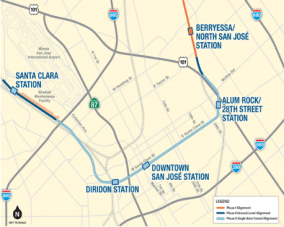 The following critique responds to the presentation made to the BART & VTA “Special Committee” meeting at BART’s Oakland Headquarters on May 31, 2019. Santa Clara Valley Transportation Authority (VTA) is proceeding with its 16 mile long, two-phased extension of BART from the current Warms Springs terminal through San Jose to a future terminal station in Santa Clara. Phase I, covering the first 10 miles of the project will be constructed mostly on viaduct and include the Milpitas and Berryessa Stations. Phase II will proceed from Berryessa for six miles in mostly subway and include the Alum Rock, Downtown San Jose, Diridon and Santa Clara stations. Phase II is where things really get expensive. According to the EIR, the total cost of Phase II is projected to be $4.7 billion. It is anticipated that bottom of the tunnel extending for five of the six miles of this phase will be 121 feet below street grade (equivalent to the height of a twelve story building) and that the tunnel hole needed for the entire 5 miles will be 55 feet 10 inches in diameter. This raises several important questions:
  Bay Area Transportation Working Group